Choosing the right materials for an industrial piping system involves more than selecting the correct pipe diameter, pressure rating, or fitting size. The way different metals interact can also affect a system’s reliability and service life.
One issue that contractors, manufacturers, and maintenance teams should understand is galvanic corrosion in pipe fittings. This type of corrosion can occur when dissimilar metals are connected under certain environmental conditions, potentially weakening connections and contributing to premature equipment failure.
At Detroit Nipple Works, we supply pipes, nipples, valves, and fittings for a wide range of industrial applications. Understanding how metal compatibility affects your piping system can help you make better material decisions before problems develop.
Galvanic corrosion is an electrochemical process that can occur when two dissimilar metals are electrically connected and exposed to an electrolyte, such as water or moisture containing dissolved salts.
According to the Association for Materials Protection and Performance (AMPP), the less noble metal in a galvanic couple corrodes more rapidly than it otherwise would, while the more noble metal experiences reduced corrosion.
Three conditions are generally necessary for galvanic corrosion to occur:
Simply using different metals within the same facility does not automatically cause galvanic corrosion. The materials, operating environment, and nature of the connection all influence the risk.
Industrial piping systems frequently contain multiple metals. Contractors may install steel pipe with brass valves, connect stainless steel components to existing carbon steel systems, or use galvanized fittings alongside other materials.
Certain combinations deserve additional consideration.
Carbon steel is widely used in industrial piping because of its strength, versatility, and cost-effectiveness. However, when carbon steel is electrically connected to copper or brass in a wet environment, the steel can become more vulnerable to galvanic corrosion.
This is particularly relevant when replacing existing valves, fittings, or sections of piping without considering the materials already installed.
Stainless steel offers excellent corrosion resistance in many applications, making it a popular option for industrial equipment and piping components.
However, combining stainless steel with carbon steel does not automatically improve the corrosion resistance of the entire assembly. In certain environments, galvanic action can accelerate corrosion of the carbon steel.
The specific stainless steel grade, operating fluid, exposure conditions, and relative surface areas must all be considered.
Galvanized steel uses a protective zinc coating to help protect the underlying steel from corrosion.
When galvanized components are connected to copper or copper alloys under unfavorable wet conditions, the zinc coating may experience accelerated deterioration.
That does not mean galvanized pipe fittings are unsuitable for industrial applications. It means the complete piping arrangement should be evaluated rather than selecting individual components based solely on their corrosion resistance.
Connections between pipes are often where different materials meet.
Pipe nipples, couplings, valves, threaded fittings, and flanges can create transition points between metals with different corrosion characteristics.
Several factors can influence corrosion at these connections:
The surface area relationship is particularly important. A relatively small area of a less noble metal connected to a much larger area of a more noble metal can experience concentrated corrosion under unfavorable conditions.
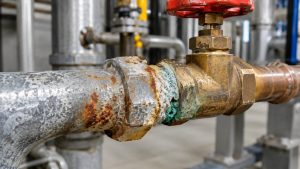
Not every corroded connection is experiencing galvanic corrosion, however. General rusting, crevice corrosion, and other forms of deterioration can produce similar warning signs.
Preventing galvanic corrosion begins during material selection and system design. While there is no single solution for every application, several practices can help reduce potential problems.
Before selecting replacement pipe nipples or fittings, identify the materials used in the surrounding piping, valves, and connected equipment.
For example, replacing a carbon steel component with stainless steel might improve the durability of that individual part. However, the change should also be evaluated for its effect on adjacent components.
Reviewing the entire assembly helps identify compatibility concerns before installation.
Where practical, using similar or electrochemically compatible materials can reduce galvanic corrosion concerns.
Depending on the application, contractors may consider carbon steel pipe nipples, stainless steel nipples, or other appropriate materials.
Material selection should account for the operating fluid, pressure, temperature, chemical exposure, corrosion requirements, and applicable industry standards.
When dissimilar metals must be connected, appropriately rated dielectric unions, isolation gaskets, or other engineered separation methods may help interrupt the electrical pathway required for galvanic corrosion.
These components must be suitable for the specific system, and installation must account for potential electrical bypass paths.
Thread sealant or PTFE tape alone should not be assumed to provide reliable electrical isolation. Systems with grounding, bonding, fire-protection, or other safety requirements need additional professional evaluation.
Since galvanic corrosion requires an electrolyte, controlling moisture can help reduce risk.
Industrial facilities should pay attention to locations exposed to condensation, washdowns, chemical solutions, salt, or standing water.
Appropriate protective coatings, drainage, environmental controls, and regular inspections can help minimize corrosive conditions.
Routine inspections can reveal potential issues before they lead to significant system damage.
Warning signs may include localized metal deterioration, unusual deposits around connections, coating damage, or recurring leaks.
Any suspected corrosion affecting pressure-containing components should be evaluated by qualified personnel. Coating over a damaged fitting is not a substitute for assessing its remaining integrity.
Not necessarily. Stainless steel is corrosion-resistant in many environments, but when connected to a less noble metal under galvanically active conditions, it can contribute to accelerated corrosion of the other material.
No. Galvanizing is the process of applying a protective zinc coating to steel or iron. Galvanic corrosion is an electrochemical reaction involving materials with different corrosion potentials.
Although the terms sound similar, they describe different concepts.
The risk is generally much lower when no conductive electrolyte is present. However, condensation, occasional moisture exposure, or changes in operating conditions can create an environment where corrosion becomes possible.
Choosing the right piping materials requires considering more than the individual product. Material compatibility, operating conditions, and the surrounding piping system all play a role in long-term performance.
Detroit Nipple Works supplies a wide variety of industrial pipe fittings, pipe nipples, valves, and piping products for customers throughout the United States.
Whether you need galvanized pipe fittings, stainless steel components, or other industrial piping supplies, our team can help you identify available products that match your specifications.
Planning a new piping installation or sourcing replacement components? Request a quote from Detroit Nipple Works or call 1-888-698-7888 to discuss your material and fitting requirements.
Posted In: Galvanized Pipe
Tags: galvanic corrosion, galvanized pipe fittings, pipe fittings