
When selecting steel pipe for an industrial, commercial, or manufacturing application, diameter is only part of the equation. Another important specification you will frequently encounter is the pipe schedule.
Terms such as Schedule 40 pipe and Schedule 80 pipe are common throughout the piping industry, but what do those numbers actually mean? More importantly, how do you determine which schedule is appropriate for your application?
Understanding pipe schedules can help you select pipe with the appropriate wall thickness, internal diameter, weight, and performance characteristics for your project.
Pipe schedule is a system used to identify the wall thickness of a pipe. You may see specifications such as:
In general, as the schedule number increases, the pipe wall becomes thicker.
One important point is that pipe schedule is different from pipe diameter. Two pipes can have the same nominal pipe size while having different schedules and different wall thicknesses.
For example, a Schedule 80 pipe generally has a thicker wall than a Schedule 40 pipe of the same nominal size.
If you need help comparing dimensions, Detroit Nipple Works provides a convenient pipe chart containing pipe dimensions, wall thicknesses, and weights.
Pipe is commonly identified using Nominal Pipe Size, frequently abbreviated as NPS.
Despite the name, nominal pipe size should not always be interpreted as an exact physical measurement of either the inside or outside diameter.
This is one of the reasons selecting industrial pipe can become confusing. You may need to consider several specifications at the same time, including:
Understanding these specifications before ordering can help prevent compatibility problems and unnecessary delays.
Schedule 40 and Schedule 80 are two of the most commonly encountered pipe schedules.
The biggest difference is straightforward: Schedule 80 pipe has a thicker wall than Schedule 40 pipe of the same nominal size.
Because the outside diameter generally remains the same for a particular nominal pipe size, increasing the wall thickness reduces the available inside diameter.
This difference can affect several characteristics of a piping system.
Schedule 80 has a greater wall thickness than Schedule 40 for comparable pipe sizes.
The additional material can make Schedule 80 desirable for certain demanding industrial applications.
Because Schedule 80 uses a thicker wall, its inside diameter is smaller than Schedule 40 when comparing the same nominal pipe size.
That difference can affect the amount of fluid or gas that can pass through a system.
More material also means more weight.
Schedule 80 pipe generally weighs more per foot than Schedule 40 pipe of the same nominal size and material. Pipe weight may need to be considered when planning transportation, installation, hangers, structural supports, and fabrication.
A thicker wall can be an important factor when designing piping for demanding applications, but pipe schedule should not be treated as a pressure rating by itself.
The suitability of a pipe can depend on numerous factors, including:
For industrial systems, pipe should always be selected according to the specifications and requirements of the particular application.
Simply choosing the thickest pipe available is not necessarily the best or most economical solution.
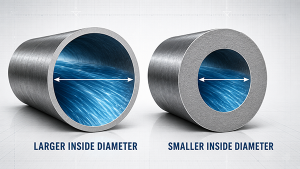
The inside diameter of the pipe helps determine how much material can move through the piping system.
A thicker pipe wall reduces the available internal space. That means switching from Schedule 40 to Schedule 80 can potentially affect flow characteristics even when the nominal pipe size remains unchanged.
Applications involving water, oil, gas, chemicals, steam, air, or other materials may therefore require careful consideration of both wall thickness and internal diameter.
This is another reason pipe schedule should be considered as part of the overall system rather than as an isolated specification.
Schedule is only one part of choosing the right pipe.
Detroit Nipple Works offers pipe and tubing in a variety of materials for different industrial requirements.
Depending on the application, options may include:
Different materials provide different characteristics related to corrosion resistance, fabrication, strength, temperature, environment, and cost.
A Schedule 40 stainless steel pipe, for example, should not automatically be considered interchangeable with Schedule 40 carbon steel pipe simply because the schedule numbers match.
Selecting the proper pipe is only one component of building a reliable piping system.
Your pipe fittings, couplings, valves, flanges, and pipe nipples must also match the requirements of the system.
When ordering components, provide as much information as possible about your application. Useful specifications can include the material, nominal size, schedule, thread type, end configuration, and required length.
Providing complete specifications helps ensure that all components work together correctly.
There isn’t one schedule that is best for every project. Before making a selection, consider the following factors:
When you’re uncertain, it is better to verify the requirements before ordering rather than discovering a mismatch during installation.
Pipe schedule may look like just another number on a specification sheet, but it can have an important effect on wall thickness, inside diameter, weight, and overall system design.
Understanding the differences between Schedule 40, Schedule 80, and other pipe schedules makes it easier to communicate your requirements and purchase the right materials for the job.
Detroit Nipple Works supplies an extensive selection of pipe, pipe nipples, fittings, valves, flanges, couplings, tubing, and other industrial piping products for customers throughout the country.
Not sure which pipe size, material, or schedule you need? Our knowledgeable team can help you identify the products that meet your project requirements.
Request a quote from Detroit Nipple Works today.
Posted In: Pipe
Tags: pipe schedule 40, pipe schedule 80