
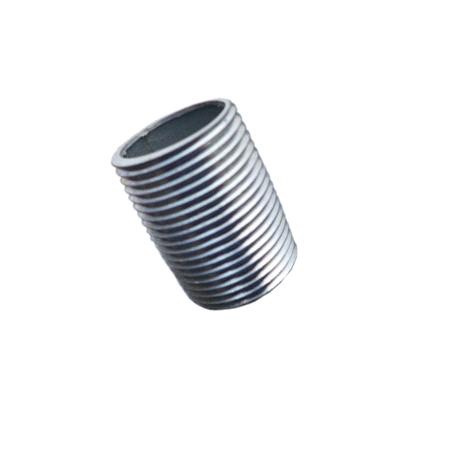
A pipe nipple may look like a simple component, but ordering the wrong one can create a surprisingly big problem. A small difference in length, pipe size, material, wall thickness, or thread type can mean a replacement does not fit the existing piping system.
If you are replacing an old or damaged pipe nipple, taking a few measurements and identifying the right specifications before ordering can save time, prevent returns, and help keep your project moving.
At Detroit Nipple Works, we manufacture and supply pipe nipples for industrial, commercial, maintenance, fabrication, and piping applications. Here are some of the most important details to check before requesting a replacement.
One of the first things you need to determine is the nominal pipe size, commonly referred to as NPS.
This is important because nominal pipe size is not necessarily the same as simply measuring across the outside of a pipe with a ruler. Pipe dimensions follow standardized sizing, so an outside-diameter measurement should generally be used to help identify the corresponding nominal size rather than treated as the size itself.
If you are uncertain, Detroit Nipple Works provides a pipe size chart that can help you compare pipe dimensions.
When requesting a quote, provide the nominal pipe size whenever possible.
Next, measure the nipple from one end to the other.
For most replacement applications, knowing the overall end-to-end length is one of the most important pieces of information you can provide. Do not assume two nipples with the same pipe diameter will automatically have the same length.
Pipe nipples are available in many standard and custom lengths. Depending on the application, even a relatively small difference can affect alignment between valves, fittings, equipment, or other piping components.
If the existing nipple is damaged or corroded to the point that it cannot be measured accurately, check equipment drawings, maintenance records, previous purchase orders, or the dimensions of the surrounding piping system.
Threads are another area where seemingly similar parts can be very different. Many piping systems in the United States use NPT pipe nipples, but NPT is not the only thread standard available. Detroit Nipple Works also supplies BSP and BSPT nipples for applications requiring British Standard Pipe threads.
Do not assume that threads that appear similar are interchangeable. If you have an existing nipple, determine whether it uses NPT, BSPT, BSPP, or another required thread specification. This becomes especially important when working with imported equipment, older machinery, OEM systems, or components manufactured for international applications.
When you are unsure, provide as much information as possible about the equipment and the existing part rather than guessing.
Two pieces of pipe can have the same nominal pipe size but different wall thicknesses.
This is where pipe schedule becomes important. Schedule specifications help identify the wall thickness of the pipe. The appropriate schedule can depend on the application, pressure, temperature, material, corrosion conditions, and system requirements.
If you are replacing an existing nipple, do not automatically substitute a different schedule just because the outside dimensions appear similar. Check the original specifications whenever possible. Providing the schedule when requesting a quote can help ensure you receive a nipple manufactured for the intended application.
The material may be just as important as the measurements.
Pipe nipples can be manufactured from several materials, including:
The right choice depends on what is moving through the piping system, environmental exposure, temperature, pressure, corrosion concerns, and compatibility with adjoining components. For example, a nipple used in an industrial process may have very different requirements from one installed in a water system, hydraulic application, manufacturing machine, or outdoor piping assembly.
When replacing a part, matching the original material specification is usually a good starting point unless the system is being redesigned or an engineer has specified a different material.
Not every nipple has the same end configuration. Before ordering, inspect both ends carefully. Determine whether you need threading on both ends or another end preparation. Depending on the application, pipe products may require threaded, grooved, beveled, square-cut, reamed, chamfered, or other end finishes.
Providing the exact end requirements helps avoid receiving a component that is dimensionally correct but cannot connect to the rest of the system. This is especially important with custom fabrication work and replacement components used in older industrial equipment.
Another detail to consider is the nipple style. A close nipple is threaded across essentially its entire usable length, allowing two female-threaded components to be positioned very close together. Longer nipples generally have a visible unthreaded section between the threads.
If you are replacing an existing nipple, take note of how much space exists between the fittings and whether the original component has an unthreaded center section. When space is limited, ordering the correct nipple style becomes especially important.
Measurements are valuable, but photographs can also help when identifying an unfamiliar replacement.
If possible, take clear pictures showing the complete nipple as well as close-up images of:
Manufacturer markings, material markings, or other identifying information can sometimes provide additional clues about the original specification. For difficult replacement parts, a photo combined with accurate measurements can provide far more useful information than a description alone.
The more complete your information is, the easier it is for a supplier to identify or manufacture the correct component.
Before submitting an RFQ, try to gather the following information:
If the application has unusual pressure, temperature, chemical, or documentation requirements, include those details as well. For custom or unusual components, drawings and photographs can also be extremely helpful.
A nipple that is slightly too long, the wrong schedule, or manufactured with the wrong threads can delay a repair or stop an installation altogether. Taking a few extra minutes to identify the part correctly can help prevent those problems.
Detroit Nipple Works manufactures and supplies pipe nipples in a wide variety of materials, sizes, lengths, threads, and configurations. Whether you need a common replacement or something more specialized, our experienced team can help you determine what information is needed to get the order right.
If you have a pipe nipple that needs to be replaced, gather your measurements and specifications and request a quote from Detroit Nipple Works. We can help you find or manufacture the pipe components you need to keep your project moving.