
Understanding pipe threads is crucial for ensuring your systems are efficient, leak-free, and safe. Among the many standards available, British Standard Pipe (BSP) threads are common, but the distinction between its two main types can be confusing. This guide will clarify the differences between BSPT and BSPP threads, their applications, and how to select the right nipple for your project.
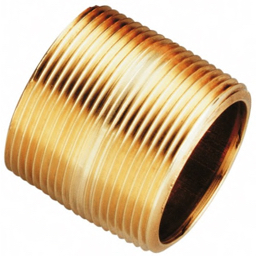
British Standard Pipe threads come in two primary forms: taper and parallel. Understanding which one you need is the first step toward a secure connection.
The most significant difference between BSPT and BSPP nipples is how they create a leak-proof joint.
BSPT nipples create a seal directly through the interference of the threads. As you tighten the fitting, the tapered male thread compresses into the female thread. To ensure a completely pressure-tight connection, a thread sealant (like PTFE tape or a liquid sealant) is applied to the threads before assembly. This fills any small gaps and prevents leaks, making it a reliable choice for systems carrying fluids or gases under pressure.
BSPP nipples, on the other hand, achieve a seal mechanically rather than through the threads. The parallel threads pull the two components together, but a bonded seal ring, washer, or O-ring is compressed between the shoulder of the male fitting and the face of the female fitting. This gasket is what prevents leakage.
BSP threads are used in two main types of joints, depending on the application’s needs.
Jointing Threads: This is the most common type, where pressure-tightness is achieved on the threads themselves. It always involves a tapered male BSPT thread, often paired with a parallel female thread. This method is standard for connecting pipes, valves, and fittings in plumbing, HVAC, and hydraulic systems.
Long-Screw Threads: This method uses parallel threads and relies on compression for a seal. A backnut is tightened against a soft material, like a gasket, compressing it to create a secure, leak-proof joint. This is often seen in applications where easy disassembly might be necessary.
British Standard Pipe Thread nipples are defined by international standards, primarily ISO 7-1 for pressure-tight tapered threads and ISO 228-1 for non-pressure-tight parallel threads. At Detroit Nipple Works, we stock a comprehensive range of sizes to meet these standards, ensuring you can find the perfect fit for your job.
Beyond size and thread type, material selection is critical for performance and longevity. We offer an extensive inventory of pipe nipples to suit any industrial or commercial application. Our selection includes:
With decades of experience, the team at Detroit Nipple Works has the know-how to help you navigate the complexities of pipe threads. Whether you need BSPT nipples, BSPP fittings, or any other type of pipe nipple, we provide high-quality products and expert guidance. We strive to deliver the best customer service in the industry, ensuring you get the right part, right on time.
Have questions about British Standard Pipe Thread nipples or need a specific material? Our experts are here to help.
For immediate assistance, call us at 1.888.698.7888 or 313-872-6370. You can also use our convenient online Request for Quote form to get started.
The history of pipe and pipe threading dates back to development in 1820 by Robert Briggs at Pascal Iron Works of the Morris Tasker Co. Located in Philadelphia PA, Robert created his first gage in 1834 to examine internal pipe threads. By 1862, he established a mating threaded ring gage for external pipe threads. It was then that he published a standard, that is now known as Briggs Standard Pipe Thread. Upon that standard, a huge majority of manufacturers began to use his threaded pipes by 1886.
Around 1905, various military and government agencies, along with The American Society of Mechanical Engineers, formed the American Standards Association (ASA). Its motive was to develop and use standards nationally. Come 1919, the American Standards Association created the National Pipe Taper (NPT) pipe threads, using the Briggs Standard Pipe Thread as its basis. Thus, the B2.1 standard was created with all taper pipe and straight pipes  specifications and gaging. Shortly afterward, the American Standards Association B2.2 standard was created in 1927 to help be of service to the automobile industry. This type of standard was a modification of the NPT pipe thread (also known as the National Pipe Taper Fuel (NPTF) pipe thread). In the year of 1961, the “Aeronautical National Pipe Taper” Threads (ANPT) were produced.
Pipe threading, with a few exceptions, are formed on the outside caliber of a piece of fitting, tubing or pipe. It is formed in the inside of the mating port, fitting, or coupling. A pipe is generally identified by the inside diameter of the pipe, thus identifying its pipe threads as well. Pipe threads are designed to be massed by hand. Depending on the size will determine how many turns it’ll take to assemble and lock together.
Pipes and fittings are primarily used to carry liquids and gasses and need threading to help make the seals better and stronger. Contact Detroit Nipple Works today for American National Standard Taper Pipe Thread (NPT) or British Standard Pipe Taper Thread (BSPT) threaded pipes. We will be more than happy to assist you.